El Niño 2026-2027: What It Means for Weather, the U.S. and Beyond
A strong El Niño is well underway and is intensifying, according to the National Oceanic and Atmospheric Administration’s Climate Prediction Center.
After tracking sea surface temperature anomalies and atmospheric conditions, there is a greater than 90% chance that El Niño will continue into the fall and winter of 2026–2027.
What Is El Niño?
El Niño refers to a climate pattern where waters of the equatorial Pacific become warmer than normal. It’s also referred to as the warm phase of the El Niño-Southern Oscillation (ENSO).
In the 1600s, Peruvian fishermen recognized the warming pattern around Christmas and called the phenomenon El Niño, meaning “Little Boy” or “Christ Child,” because it often appeared around the Christmas season.
For an El Niño event to be officially declared, sea surface temperatures in the central and eastern tropical Pacific must remain at least 0.5°C above average for five consecutive overlapping three-month periods, along with corresponding changes in the atmosphere.
What Happens During an El Niño?
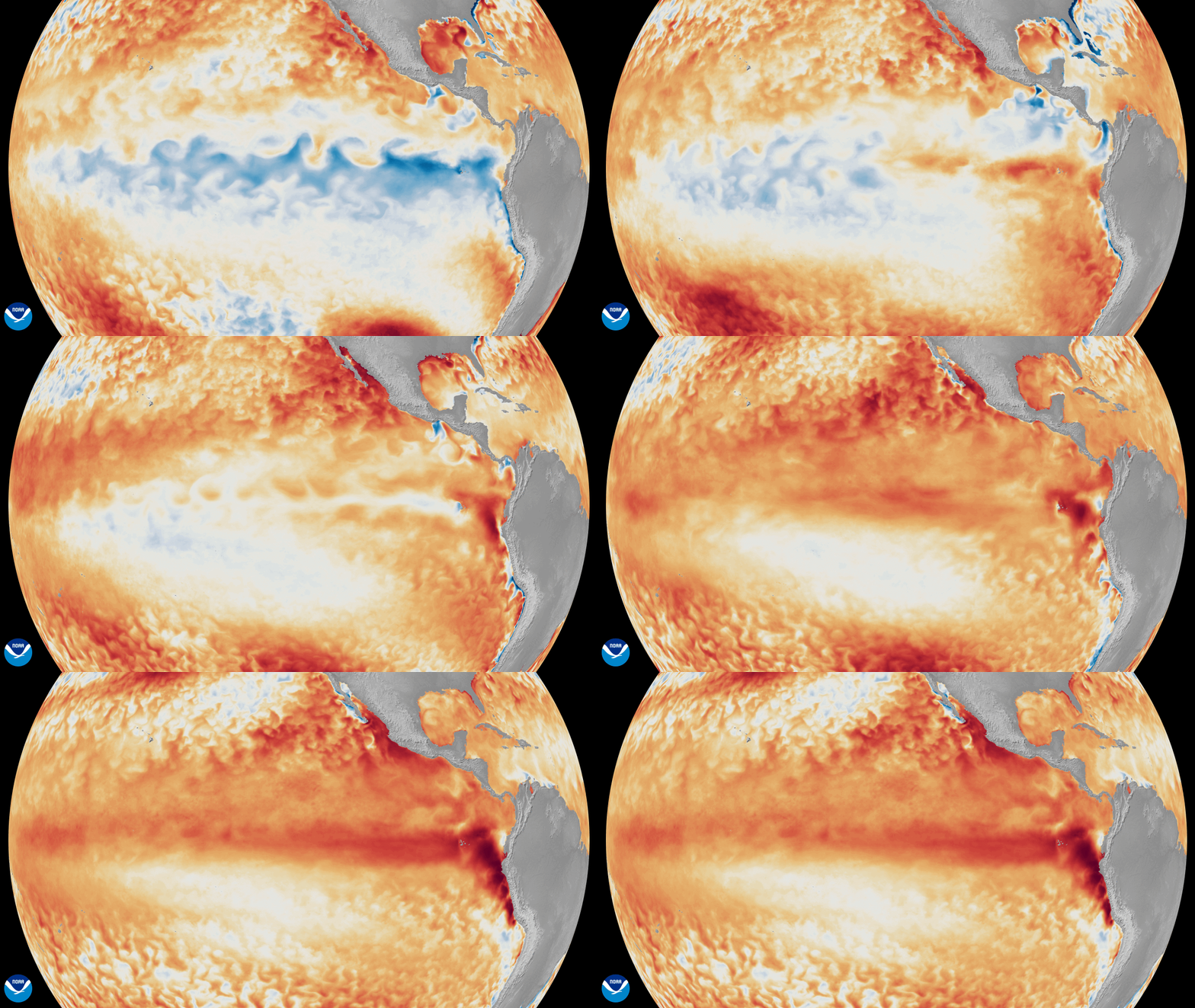
During an El Niño phase, the trade winds weaken as warm water shifts eastward toward the west coast of the Americas.
This pattern can have a significant impact on weather globally. The unusually warm waters can cause the Pacific jet stream to shift south and farther east from its typical position.
This change can lead to wetter-than-normal conditions across parts of the southern United States, while areas farther north, including parts of the northern United States and Canada, can experience warmer and drier-than-normal conditions, particularly during the winter months.
How Does El Niño Affect Marine Life?
In addition to having a large impact on weather patterns across the globe, El Niño affects marine life.
Normally, cold, nutrient-rich water from the depths of the ocean rises toward the surface. This process is called upwelling and brings nutrients to phytoplankton and other marine life.
However, upwelling weakens during an El Niño phase. With fewer nutrients reaching the surface, there can be fewer phytoplankton off the coast. This can affect the fish and other marine life that depend on them for food.
The warmer waters can also cause tropical species, such as yellowtail and albacore tuna, to move into areas that are normally too cold for them.
What’s the Outlook for the 2026–2027 Season?
On the heels of a very warm July, El Niño is expected to continue strengthening.
As of August 13, 2026, sea surface temperatures in the Niño-3.4 region were significantly above average, with the latest observations showing a strong El Niño signal. NOAA’s latest outlook indicates that El Niño will continue strengthening through the end of the year.
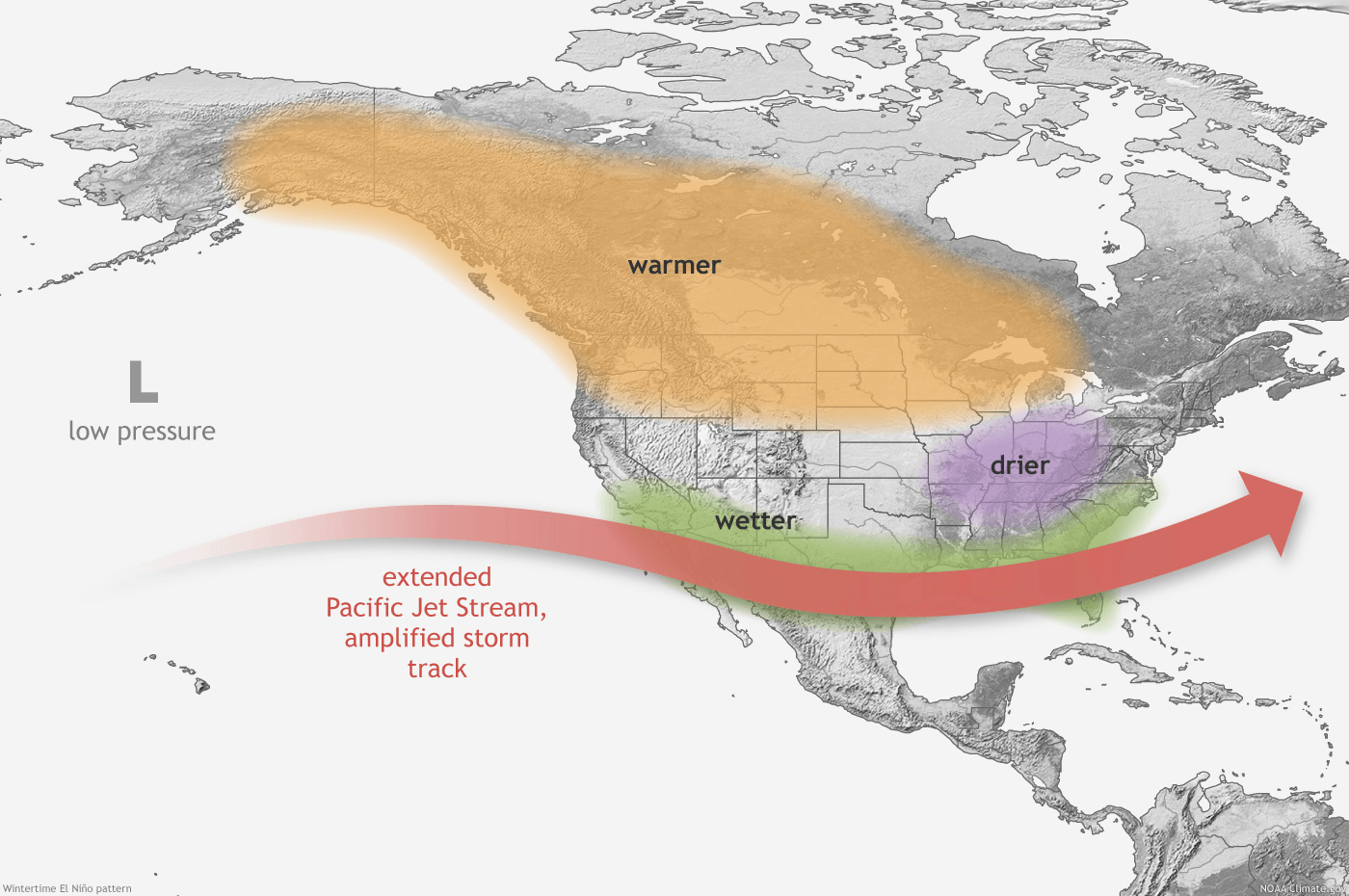
This map shows the typical impacts of El Nino to the continental U.S. and Canada during Northern Hemisphere winter. (Image credit: NOAA)
According to NOAA, There is a 69% probability that this El Niño could become historic during the October–December 2026 season, potentially challenging records dating back to 1950. The agency defines a historic event as one that reaches or exceeds +2.5°C for the three-month Relative Oceanic Niño Index (RONI).
During the summer months, strong upper-level wind shear across the Atlantic can disrupt tropical systems and make it more difficult for storms to develop or strengthen.
Meanwhile, in the Pacific, weaker wind shear combined with warmer-than-normal ocean waters can create a more favorable environment for tropical development, particularly across the Central and Eastern Pacific.
Additionally, El Niño can contribute to drought and low water levels in parts of Asia, Australia, Central and South America. It can also influence the timing and strength of monsoon rainfall in parts of Asia.
In the United States, El Niño can also bring wetter-than-normal conditions to parts of the South and Gulf Coast, while the northern tier can experience warmer and drier conditions.
Global heat waves are also a concern as the Pacific Ocean continues to warm, while changes in atmospheric circulation can influence wildfire risk across parts of the world.
The bottom line: this could be a significant El Niño, and we’ll be watching closely to see just how strong it becomes and what impacts it brings during the 2026–2027 season.